
Building Cozyvale: A World of Small Problems and ‘Filthy’ Chai Lattes
On leaving BookCon 2026 creatively inspired, breaking a months-long rut, and letting a silly guy finally build a silly valley.

I left BookCon 2026 on Sunday afternoon, the Javits Center behind me, and walked home feeling creatively charged for the first time in months.
It was the second and final day of the con. I’d spent the weekend listening to authors talk about worldbuilding, strong female protagonists, and how to write morally grey characters. One theme kept surfacing in panel after panel: cozy. What cozy means. How it works. The insistence, over and over, that cozy is here to stay.
I’d written about whether D&D can be cozy a while back. That’s Can D&D Be Cozy?. A simple thought experiment. But sitting in a panel on the future of high fantasy, listening to authors name dark academia, grimdark, and cozy as the genres defining the next few years, I stopped thinking about frameworks. I wanted to build something.
I got home, opened a blank page, and spent the next three or four hours doing serious worldbuilding on Cozyvale, a place I’d been carrying around in the back of my head since that original article. This post is what came out of it.
Why Cozy, Why Now
I’ve been in a creative rut for a few months. Not a block exactly. I’ve been shipping. I write a lot of articles here on Substack, and I prep often for my weekly Vecna: Eve of Ruin campaign. But it’s been a while since I felt like I was creating something that was just mine, something that wasn’t for anyone else.
Cozyvale is for me.
One of the panelists made a point that stuck. Horror and cozy hit the same nerve. They answer the same need. People want to escape, and they want to feel safe. Some of us escape by turning the dial all the way up on dread. Some of us escape by turning it all the way down.
My Vecna campaign is the horror dial cranked high. Multiverse monsters, all-powerful gods, stakes that could unmake reality. I love running it. But if you’re living in the US in 2026, you probably don’t need me to tell you that things feel uncertain right now. A lot of us are looking for somewhere soft to land.
That’s what cozy games give people. Stardew Valley. Palia. Recettear: An Item Shop’s Tale. Coffee Talk. Books where the stakes are smaller and the light is warmer. Cozyvale is me asking the same question those games ask. Can the worlds we build, and the worlds our players play in, be more relaxing than stressful? Can they be about achieving small things instead of saving the world?
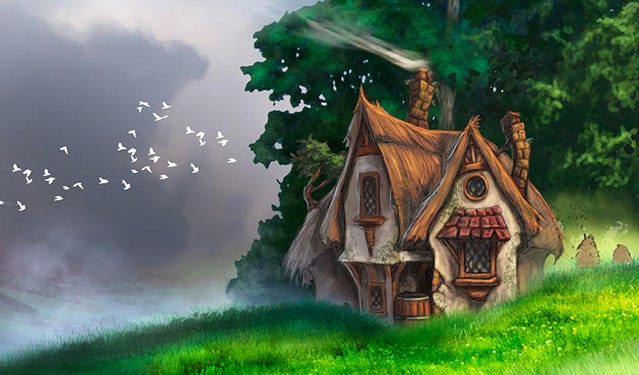
A Tour of Cozytown
Before I thought about regions or geography or history, I thought about a town.
Cozytown is the beating heart of the Vale. A cosmopolitan village dotted with cafes, blessed with sunny days and welcoming of rain. The main challenge on any given day is figuring out what’s for dinner. Most folks would rather read a book and mind their own business.
Here’s what’s there so far:
Boulder Hill. An oversized boulder sitting right in the middle of town. Nobody knows if it’s the eye of a long-buried giant, or its kidney stone. Children scrawl chalk drawings on it. The rain rinses the canvas clean. I love it because it’s so low-stakes it loops around to being delightful.
The Cozytown Museum. Held open by a quiet, old magic that responds to what’s inside. Donate an artifact and a wing blooms. Sell one off and the walls crack. Oswald Tealeaf, the curator, has had to sell pieces off to pay rent, and the place has started falling apart. He’s looking for adventurers willing to help him rebuild it by bringing things home.
In Bean We Trust. Cozytown’s coffeeshop, run by a giraffe named Juniper Demaia. Famous for filthy chais (extra espresso shots softened by the Vale’s magic beans so the spice stays bold). Seasonal bean rotations tied to the weather. A corkboard of found bookmarks, love notes, and grocery lists that customers leave for other customers to pick up or fulfill.
Munstrous Bakery. Run by an ogre couple, Mister and Melanie Munster. Their cakes and pies are ogre-sized by default, though you can ask for one cut down to human. Mister keeps a journal of failed bakes. Melanie spins cotton candy in flavors like thunderstorm, peanut butter and jelly, and coffee.
Lots-a-Books. A bookstore built in the shape of an open book. Run by Lots-o, a werebear man in glasses who’s hoarding a private collection he secretly plans to donate to the museum once the set is complete. The top seller right now is Romantasy, of course. A tea station sits in the corner, because Lots-o insists books and tea go together.
None of these were designed. They accreted. I leaned into my silly side and stopped second-guessing. A lot of what I write for my table is serious: end-of-the-world stakes, death around every corner, fate in the players’ hands. But I’m actually a pretty silly, goofy guy in real life. Cozytown is the first place I’ve built that sounds like me when I’m relaxed.
Some of these names are quiet tributes. Mayor Gustopher, the young green dragon who runs the town, is a nod to Gus, a familiar at my table. Tealeaf is an homage to another friend’s character. If you’ve been in one of my games, you may recognize a fingerprint or two.
The Kinds of People in the Vale
The Vale has three kinds of people. They are all people.
Humanoids are the D&D you already know: humans, elves, dwarves, halflings, the whole lineup.
Talking animals are the second group. Sentient, bipedal, fully themselves. Raccoons, rabbits, frogs, otters, giraffes. I don’t know how you resist talking to a gopher, or a beaver named Billy. I don’t want to resist it. So they’re here.
Monstroids are the third. They’re the monsters of traditional fantasy, except they’ve been allowed to have personalities. I love monsters in D&D, and it bothers me how rarely they’re allowed to be people. Orcs are vicious. Ogres are stupid. The undead hate the living. That’s the default.
In Cozyvale, the orcs run bakeries. The ogres bake ogre-sized cakes and also regular cakes, because they’re thoughtful. The undead mostly keep gardens.
Coffee Talk pointed the way here. In that game, you pour drinks for orcs and merpeople and werewolves, and none of them are there to fight you. They’re there to talk. Cozyvale runs on that premise.
For the specific cast of Cozytown, I used a structure I’ve been practicing in the last few articles: less physicality, less personality, more Wants and Methods. A few examples:
Juniper Demaia wants the Vale’s magic beans. Her method is charm. She pulls gossip out of her customers and leaves surprise gifts for regulars.
Oswald Tealeaf wants his museum whole again. His late wife gave him a stone. He keeps it in his pocket. He’s an otter, and otters collect what their loved ones give them. He hires adventurers and always has a fact at the ready.
Mister Munster wants to bake the perfect, impossibly large tiramisu. His method is ingredients, experimentation, and a journal of failures (the Avalanche, the Last Resort). Melanie prefers smaller things and spins cotton candy like weather.
Lots-o wants to complete a set of rare books called Mortimer’s Treatise. His method is buying, quietly. He tells no one about the donation plan.
When I prep a character this way, the hooks write themselves. Oswald needs help. Juniper knows everything. Mister and Melanie are the reason half the town is happy on any given afternoon. Lots-o and Gustopher are already in a running feud over borrowed books that never come home.
Building the Bones
I wrote a chapter on worldbuilding for my upcoming book, and I realized while drafting this post that the chapter was the last time I actually did any worldbuilding. I’d written about the practice without practicing it.
So this weekend I tried to put my own chapter to work.
I went broad first. The Vale as a region. A few pieces of terminology. I didn’t write paragraphs. My background is in writing, and my instinct is to keep editing the first sentence until it sounds finished. That’s how I end up with nothing on the page. So this time I typed the name of a place, three bullets of what made it interesting, and moved on.
I love the phrase filthy chai and had no idea what it meant when I wrote it down. I thought about it later. That’s the order I want. The name or the image first. The explanation second, if at all.
When I hit a gap, I didn’t fill it with prose. I asked a question. How do you get from one side of town to the other? There’s a river. What’s the river called? River Tam. Where does it start? Misty Falls. Where does it end? Beaver Lake. What do people do at Beaver Lake? Swim. Have picnics. Cause low-stakes mischief. Good enough. Next question.
Some sections are still just flags. Geography is a stub. The Vale’s history is a stub. I haven’t figured out what the monstroids’ cultures look like or where the other settlements are. I left big yellow TO DEVELOP notes in those places and walked away. They’ll get filled in when I’m ready. Not before.
The process felt good. Slow, methodical, generous with itself. No pressure to make any one piece load-bearing.
What Comes Next
Eventually I’ll think about mechanics. How cozy play actually runs at the table. How bastions, to-do lists, spells, and gear shift when the genre shifts. That’s a different article, and I’m not there yet.
For now, I just wanted to build a place and share it. Thanks for reading.